
David Holthaus is an award-winning journalist who has covered the civic and community life of the greater Cincinnati area for more than three decades, working for both the city’s daily papers, the Post – until it closed in 2007 – and then the Enquirer, as well as a local TV station. He has also launched an online magazine, Soapbox Cincinnati, and has contributed to a range of other publications.
Last year, he was named the Best Freelance Journalist in Ohio by the Press Club of Cleveland.
You can read David’s full bio at the Conversations page.
Along with our mutual friend, David’s former Post colleague Keith Herrell, we went to watch the Cincinnati Reds pull out yet another dramatic win at Great American Ball Park against the Seattle Mariners.
*
Steve – What was the first baseball game you went to and what do you remember about it? What do you think about how the game has changed since then? Who was your favorite player growing up?
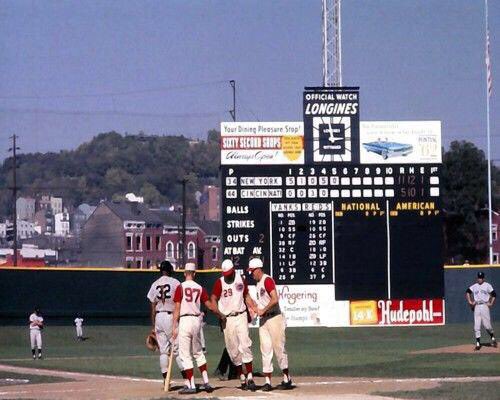
David – My Dad took me to my first game at Crosley Field in Cincinnati. Crosley was a wonderful old ballpark with some great quirks like “The Terrace” in left field, where the field actually sloped upward to the wall, and the Longines clock above the scoreboard in center field. It was in an old, sort of industrial neighborhood and going there just felt like going into another world, with the smells of peanuts, hot dogs and beer and the noise of the crowd.
The ballparks have certainly changed since then, despite the efforts to recreate the charms of those old parks. The music is much louder (not much live organ music anymore!), the massive scoreboards are entertainments in themselves.
I think the game has become less nuanced, especially with the DH in both leagues now. I also wonder why starting pitchers could pitch complete games back then but can’t now. More emphasis on power now, it seems. I do like some of the changes, especially the pitch clock. The games were getting way too long.
Growing up, my favorite player was undoubtedly Pete Rose. He was such a fierce competitor and a clutch player, and also a “Cincinnati kid,” having grown up here. His hustle and style of play was a model for me as a kid just starting to play baseball, as well as for many others around my age growing up in Cincinnati. Of course, the Pete Rose story went off the rails. When I moved back to Cincinnati to work at The Post in 1989, the Rose gambling story was in high gear. It was little disorienting to see a boyhood hero fall from grace like that. It’s a real tragic story. But he’s still revered in many parts of Cincinnati. And yes, he deserves to be in the Hall of Fame, as I have editorialized several times. (Steve – I’m with you. I believe there are players – Barry Bonds too – where the Hall should just “put the whole story on the plaque” and let people make their own minds up).
*
Steve – When we spoke, you mentioned you’d travelled to a number of different ballparks with your son. What’s your favorite place to watch baseball, and how important do you think it is to preserve the generational continuity of the game?
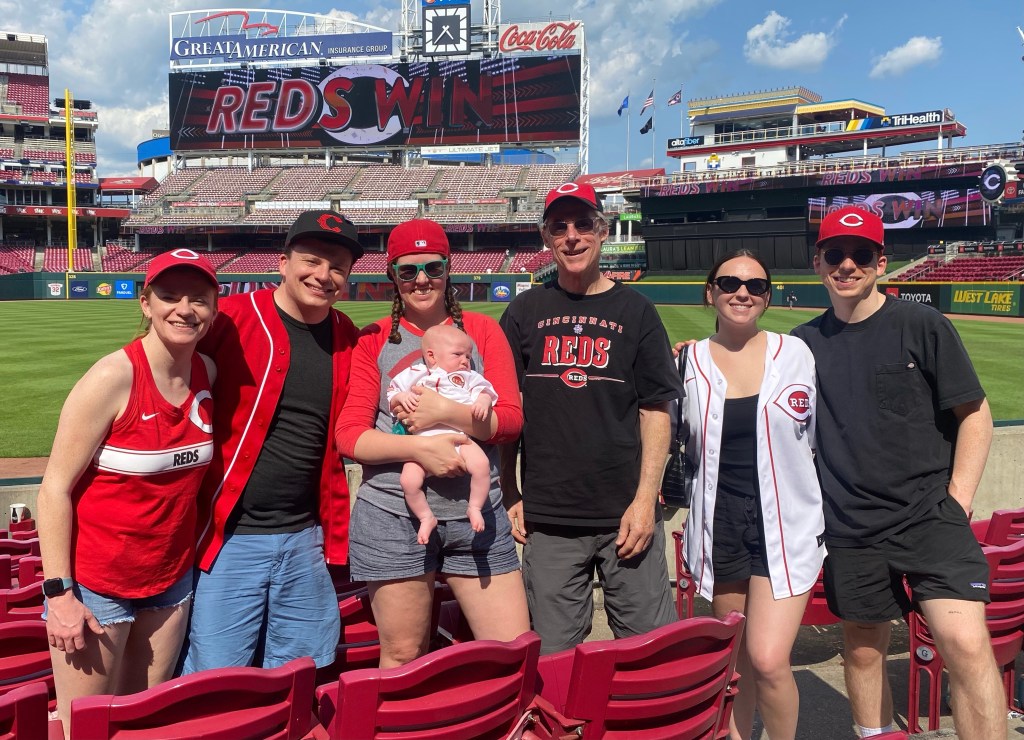
David – I’ve always loved Wrigley Field and have been there many times. But I think Great American Ball Park in Cincinnati is my favorite place, especially watching games with family. My now-grown children, two of whom live out of town, and I still get together to go to games there. It was a joy to accompany my grandson to his first baseball game, which was at Great American last summer. He was only three months old at the time, so many more to come, I hope. Baseball is a great connector for us, as it was for my Dad and me. So important for families – and for the game.
*
Steve – What was the first election you voted in? What do you think have been the most significant changes in our politics since then, and do you think voting means the same to people as it once did?
David – As an 18-year-old, I voted in the 1976 presidential election, Jimmy Carter vs. Gerald Ford. Ford was the unelected incumbent who had pardoned Nixon. Carter won, of course, but could not win a second term. It’s been gratifying to see how active he has been in serving his communities since his presidency.
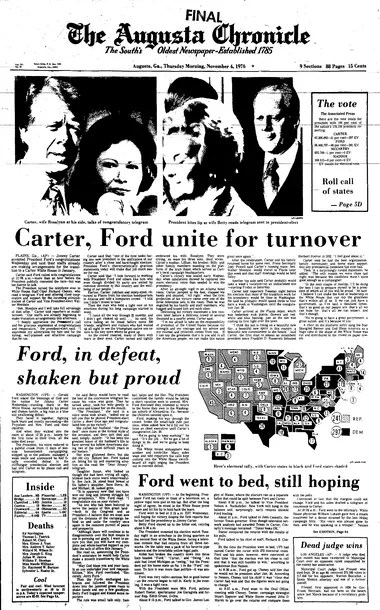
I’m taken aback by how politics have changed since then. It seems all about accumulating power now, even if it means destroying the other side. Nixon was a power-hungry president with a dictatorial streak, but there was a bipartisan investigation of him, and both parties were prepared to impeach him. Hard to imagine that happening today. The disinformation and outright lies now being used to accumulate power are particularly frustrating to see, as a journalist. Facts don’t seem to matter. Impeachment is being used as a political tool. People we’ve elected to lead us are in it for themselves, not for their country or their communities.
I remember a time when encouraging voting was the civically correct thing to do. There was always lots of concern – on both sides – about how to get more people to vote. Now, one party is actively working to suppress voting – pushing for fewer early-voting days, restricting mail-in voting, fewer ballot drop boxes, requiring voter ID, and so on. The same party has also undermined the results of a fair, legitimate election. No wonder people feel alienated and are losing trust in the process.
*
Steve – We’ve just had a hugely significant set of off-year elections in Ohio, and also across the river in Kentucky – both “red” states but where voters seemed to be turned off by extreme positions. What do you think those outcomes tell us about how the coming year is likely to unfold, in terms of priorities and issues?
David – Unfortunately, I don’t think traditional issues will matter much this year. We’ve already been consumed by Trump’s legal issues, which will continue all year, by Biden’s age issues, and by the impact of two foreign wars. Americans will need to decide who is the better person to deal with a country and a world that dials up crises on a regular basis.
Steve – Some fights look set to continue, with the local GOP committed to contesting the abortion rights issue, as well as the ongoing dispute over re-districting. Have local and community politics inevitably become more important than national?
David – I don’t think so. I feel local and community issues have become lost as people have chosen up sides in the national political conversation. But local issues are the very matters than can affect people’s lives on a daily basis, and also where they can create some impact. Unfortunately, local leaders get caught up in culture war issues and other nonsense, and fail to act on the things that matter.
Here in Southwest Ohio, we’ve had small-town legislators weighing in on transgender issues, and passing local resolutions on abortion and guns. They waste time and energy that could be better spent on improving their communities, like making plans for smart growth, bettering their neighborhoods, improving the standard of living, and adapting their infrastructure to neighborhood scale.
Steve – And following on from that, how well covered are the politics of Cincinnati and its surrounding area by the current local media? How does that contrast with the time when there were two competitive daily papers, and how much have online news sites – like the one you started – filled in the gaps? Tell us a little about how that start-up happened and the journey since then.
David – When Cincinnati had two papers, they competed hard for news. Reporters and editors lived to beat the other guy. The community benefitted from that competition, as well as from the two editorial voices. But the afternoon paper closed more than 15 years ago, and the morning paper has been steadily downsizing since then. It no longer has the resources to provide consistent, aggressive, analytical coverage of local politics, government, and business. Local TV news can fill some gaps, but is still dominated by “if it bleeds, it leads” philosophy. The community is not served well by this lack of coverage. We don’t know what we don’t know. The local paper’s online report is filled with high school sports, restaurants opening and closing, and Taylor Swift. All worthy subjects, but in an era of limited resources, this is how you spend them?
Soapbox Media was started following the demise of The Post when a groundswell of influential people in town expressed a desire for another voice in local journalism, one whose content was not dominated by crime, car wrecks, scandals, and “he said/she said” stories. There was a desire for a solutions journalism approach, where problems are not ignored, but potential solutions to them are just as newsworthy as the problems themselves. Soapbox has successfully practiced this approach for 15 years, but its resources are even more limited. It does have an engaged audience, and it does have influence, as its stories often lead to wider coverage by traditional media.

*
Steve – We talked a little about the shift online and changes we’ve all seen during our careers in the news business, but the biggest one may yet turn out to be how Artificial Intelligence is used in newsrooms. How do you see that playing out, especially in the context of the challenges that were already facing local media organizations?
David – I think it may further erode trust in media, unfortunately. It may generate more suspicion and mistrust among the public. Local media will have to work harder to build trust. In my opinion, that can be done with consistent, aggressive, serious reporting. AI can’t do that. But media companies can and should use AI to analyze their own coverage and readership and make improvements.
Steve – The constant with every successive technological change in our industry seems to have been that it alters how audiences consume and interact with information. In a world that seems to be drowning in podcasts, do you still buy books? What have been some of your favorites recently?
David – I love to read and buy books. Much more relaxing than a podcast or reading online (although I do those too). Recently read “The Wager” by David Grann. Subtitle: “A Tale of Shipwreck, Mutiny and Murder.” I love good narrative nonfiction like that. Big fan of Jon Krakauer’s work. Recently reread “Into the Wild,” which is an excellent work of narrative journalism. I mostly stick to that kind of nonfiction, although I recently read Amor Towles’ “A Gentleman in Moscow,” which was a gift from my oldest son.
*
Steve – Finally, back to baseball. There’s been quite a contrast in the Reds, between the EDLC-fired optimism of the 2023 season and the intense antagonism towards the ownership during the previous 100-loss year. For one of the games against the Cubs this past year, I saw GABP as full as I’ve ever seen it for a game that wasn’t Opening Day.
What are your expectations for the coming season, and psychologically, how important is it for the local community to have a winning team? Especially in a city with such a history of success?
David – The 2023 season was more fun than Cincinnati has had with baseball in a long time. It was because expectations were so low, and a very young team played with energy and actually made a run for the playoffs. It brought the city together around baseball, and the vibe was really strong. There was a palpable optimism in the air. It was a great feeling, and that’s super important for a “small-market” town like Cincinnati. Not sure that can be duplicated this year. It had the feel of a once-in-a-generation thing. So I’m keeping my expectations low. Better to be surprised than disappointed.
*
You can follow David on Twitter/X here, and follow Soapbox Cincinnati here.
***
You might also enjoy these other Conversations:
Chris Lamb – Circus Peanuts
“I went to my first game on October 2, 1964, when the Cincinnati Reds played the Philadelphia Phillies at Crosley Field. I was six. I don’t remember much about it, though I later learned it was quite an extraordinary day. I wrote a piece about the game for The Huffington Post.“
*
Cam Miller – ‘This is a Baseball town…’
“Baseball, more than any other sport, relies heavily on tradition and family. And there is no city in the world that encompasses that mix of baseball, tradition and family like the Queen City. It’s just different here. There is no city that does what we do.”
*
Danny Knobler – Relief
“What attracted me to the game was the day-to-day nature of it, watching a pennant race and living with it every day as the summer wore on. I turned 13 in 1974, when the Dodgers were battling the Reds and eventually winning the West by four games… The Reds were the big rivals so we didn’t like Pete Rose, but we also loved watching him play. Home runs were nowhere near as common then as they are now, so it was special to see the big hitters like Hank Aaron and Willie Stargell. And as with any kid growing up in LA at the time, Vin Scully meant as much to us as any player.”
***
 States of Play