

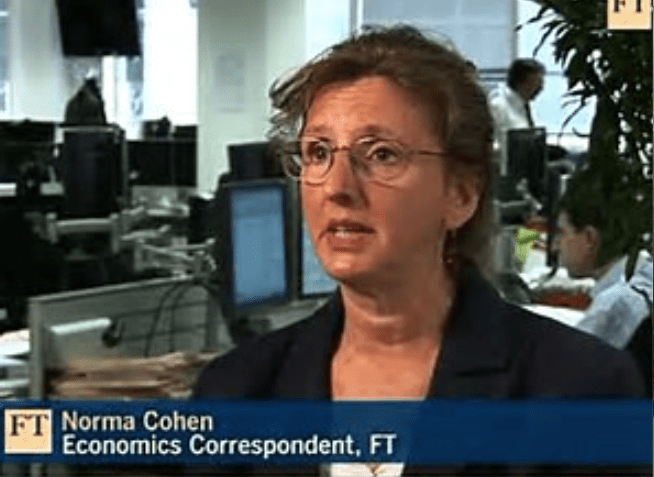
After graduating from Columbia’s Graduate School of Journalism, Norma Cohen joined Reuters in New York, covering capital markets, economic and monetary policy. She was posted to Reuters’ London bureau in 1986, covering capital markets and regulation, and has lived in Britain ever since.
Read Norma’s full bio at the Conversations page
*
Steve – You’ve been in London long enough to appreciate the differences between the two societies, so let’s get the whole “compare and contrast” thing out of the way upfront. We’ll come on to our respective politics in a bit, but is there maybe one thing that’s still surprising to you?
Norma – Yes. I have never been able to understand the nuances surrounding ‘social class’ in Britain. Tell me why someone with an ancestor who was connected to land and wealth is automatically granted social status, whereas someone who went out and grafted is not?
Steve – What was the first baseball game you went to and what do you remember about it? Have you been to a game recently? I know for some reason you’re an Arsenal fan – and their women’s team has had a great season this year. How would you compare watching sports in the US and Britain?
Norma – I can’t remember my first game but I’m sure it was at Shea Stadium to watch the Mets. The most recent game I went to was with our kids, maybe twenty-five years ago, at Yankee Stadium. Our son, who was about 7, was developing into a cricket fan after going to a match at the Oval and we wondered how he would react to the raucous Yankee fan atmosphere. But by the 7th inning stretch, he was up and singing ‘Take Me Out to the Ballgame’ and shouting at the umpire that he had called a strike wrong. Totally abandoned his gentlemanly cricket decorum at the front gate.
I loved ice hockey – I’m still a die-hard NY Rangers fan – but I watch sports much differently now. Because my children are so completely Arsenal maniacs – my daughter is fantastically knowledgeable about European football – I watch sports much more closely in the UK than I ever did at home.
I cried watching England’s women’s football team win the Euros last year, and am excited to see how they’ll do in the World Cup this summer.
*
Steve – What was the first US election you voted in? What do you think have been the most significant big-picture changes to how the political system works – or doesn’t – since then? Are you still registered to vote in New York? Do you?
Norma – The first election in which I voted would have been for Mayor of New York City in 1973, which led to Abe Beame taking over from John Lindsay. Beame made history by becoming New York’s first Jewish Mayor and, of course, his time in office came at a difficult period economically for the city.

I had initially registered as an independent but quickly realised that in NYC, the ‘real’ election is not the general election but rather the Democratic primary. I switched to register as a Democrat, where I remain. And yes, I still vote in NY County at my last US address, on 181st Street in Washington Heights.
For me, the biggest single change has without doubt been the advent of ‘Dark Money’ into our election process. The ‘Citizens United’ case was nothing less than a vote against democracy.

*
Steve – After some pretty performative politics, the negotiated debt ceiling Bill finally passed and will, hopefully, avert the possibility of a US default. Since you’ve studied the idea of historical debt – and your work on Britain and the First World War has some parallels with the US government’s bond issuance from the Civil War onwards – why should the idea of a nation paying bills it has already run up be a hostage to political theatre? Would we be better off if the concept didn’t exist?
Norma – I have zero arguments against scrapping the Debt Limit altogether. Only the US and Denmark have such a thing. It does not limit the ability of governments to spend; it limits only the ability to pay bills it has already incurred. It was enacted during the First World War amid concerns about the record debts the US was racking up; but now it is little more than an opportunity for the out-of-power political party to hold government to ransom and grandstand. SCRAP THE DEBT LIMIT NOW!!
*
Steve – On the broader global economic picture, is there any Western society that you think is particularly well-placed to weather the shifts we’re seeing in demography and economics? In France, the protests over President Macron’s changes to the state pension age (among other things) have drawn attention to the differences between national approaches to retirement.
In Britain, meanwhile, we continue to realise how much our economic health has been damaged since Brexit. What do you think is the outlook for Britons approaching retirement? We’ve already had some relatively restrained pension protests, but what might it take for Britons to take to the streets like the French? Or do we just not do that sort of thing here…?
Norma – It is a bit ironic perhaps that France, of all European nations, is doing better than most in what I regard as an even greater demographic threat than rising longevity at older ages. That is, fertility is falling everywhere. We are simply not producing enough babies to even keep population stable. France, among European nations, is closest to having a fertility rate that is just below replacement rate, far ahead of Italy, Spain, and most nations in Central and Eastern Europe. We are starting to see some of the economic effects of this showing up in tight labour markets, despite weak economic activity across Europe.
As for Britain, what we need is more widespread acceptance of the need to work much longer than we already do. To put this in perspective: Britain set its State Pension Age at 65 years in legislation passed in 1925. In the English Life Table covering that period, a man born in that decade would, on average, live to only around 56 while a woman might live to age 59. In other words, most born in that decade would, on average, never live long enough to draw a State pension.
I recently wrote a note for the National Institute of Economic and Social Research on why economists need to pay attention to population change. In order to avoid a France-type street revolt, demographers, economists, policy makers and elected officials need to talk realistically about what retirement is and what it is not.
*
Steve – You and I both worked in journalism through what we thought was the industry’s most transformative – and often traumatic – quarter-century. But technology is again changing the relationship between journalists and readers, one that’s already stretched, if not broken, because of fake news and disinformation. Do you think journalistic credibility and trustworthiness are valued the way they used to be, and how do you think journalists can best go about rebuilding that relationship?
Norma – It has become too easy for journalists – and their editors – to fall into the trap of producing ‘clickbait’ – material that they know will receive a lot of clicks or go viral on social media sites in order to generate more ad revenues. It might be too late to change this, but it should be resisted vigorously.
To me, one of the most dangerous trends of the past 20 years has been the collapse of local newspapers, both in the US and in the UK. Local papers are what hold politicians to account and there should be some practical way of subsidising good local journalism to keep it alive. It is what ensures the continuation of democracy.
Steve – We’re about to start the 2024 US electoral cycle in earnest, on what appears to be a track towards a re-run of the 2020 presidential contest, despite most Americans seemingly having little appetite for going through it again. Do you get a sense that the country might break out of its political division anytime soon; and because of some demographic changes, is the center of power inevitably shifting from a national level to state and local battlegrounds?
Norma – No, I see no sign that America is shifting out of its partisan gridlock. The legislative pragmatism around the debt ceiling is encouraging, but while the former President has such a hold on his party, it’s hard to see how we get back to “normal” politics.
What worries me most is what is going on in State houses in places like Texas, where rural politicians are trying to ensure that ‘blue spots’ in their densely populated urban areas have their political clout reduced and voting rights limited. My view is that democracy – as a process – faces some very real threats in America. I am particularly worried about this.
(Note: Americans generally seem to agree, but – as usual – can’t decide exactly why…)
Steve – Finally, back to games, at least tangentially. Is there anything you think a fundamentally simple pastime like baseball can teach us about our everyday lives? Or maybe you subscribe to Noam Chomsky’s broadbrush idea that sports are there to distract us from things that are really important?
Norma – No, sports are to be enjoyed. They are visible centres of human achievements. How can anyone watch Manchester City and not think that? So long as we understand what we are watching and why, sports are a healthy, temporary distraction and deserve our full attention.
*
Follow Norma on Twitter here.
*
You might also enjoy these other Conversations:
Alina Utrata – ‘Musk And Managing The Message’
“Sports are unavoidably political – you can see that in Iran, where women have not been allowed to attend football games. Or both here in the UK or US, where women’s sports are not given the same kind of resources or respect, or trans athletes may be banned from competing. That’s a political statement about who we feel should be included and valued in society.”
*
Beth Ely Torres – ‘About-Face‘
“Local politics may not be able to solve the big issues, but they can certainly feel the pulse of what constituents need. But local politics can also hurt the country. Like primaries, many people don’t see the importance in voting in the local elections. We often get left with radicals on both sides that care more about their personal agenda than what is good for their constituents. In the long run, this shapes how people view the larger areas and creates a larger divide.”
*
Rose Jacobs – ‘Spartan Strong’
“I worry about media distribution – who’s reading this stuff – less because of what it means for ad revenues, and more because I think we as a nation really, really need to step up our awareness of what’s going on, not in terms of which party is winning, or which celebrity politician is annoying us, and more in terms of the issues at hand.”
*
 States of Play